E-Bike Motor Manufacturer: Three Electric System Guide — Motor, Lithium Battery & Controller Explained
Why a Complete-Bike Factory Talks About the Three Electric System
We have exported bicycles from Tianjin for over a decade, and the fastest-growing category in recent years is the e-bike. Many buyers choose an e-bike by looks and price alone, yet roughly seventy percent of the riding experience is decided by the three electric system. In this guide we lay out the parameters and matching experience proven on our own mass-production lines, so you can specify with confidence.
What Is the Three Electric System
The three electric system covers the three core components — the e-bike motor, the lithium battery and the controller — completed by the display and sensors that close the electrical chain. The analogy is simple: the motor is the muscle, the battery is the fuel tank, the controller is the brain, and the display is the nerve ending. Voltage platforms, power ratings and communication protocols must match across all of them — if any one component lags, the whole bike underperforms.
The Motor: Hub Drive vs Mid-Drive
Working with every major e-bike motor manufacturer, we run two motor types on our production lines. The rear hub motor — a brushless unit built into the rear hub — powers our city commuters at 250 to 350 watts rated with 35 to 45 Nm of torque: simple, low-maintenance and cost-effective, and the biggest seller into Africa and the Middle East. The mid-drive motor mounts at the bottom bracket and drives through the chainring; at 250 watts rated it delivers 65 to 95 Nm of torque, with centered weight and strong climbing — the choice for e-mountain bikes and Europe's high-end market, at two to three times the price. Both types pass a 48-hour salt-spray test, with winding temperature rise held inside spec.
Lithium Battery and BMS
The battery accounts for over a third of total bike cost. As the integrator of each e-bike lithium battery supplier in our chain, we spec two platforms: city bikes run 36 V at 10.4 to 17.5 Ah (375 to 630 Wh) for 50 to 90 kilometers of range; e-MTBs run 48 V at 14 to 20 Ah. Cells are 21700 format, retaining 80 percent capacity after 800 to 1,000 charge cycles. The critical part is the BMS: over-charge, over-discharge, over-current, short-circuit and temperature protection are all mandatory. Our Kuwait and UAE customers face ambient temperatures near 50 °C, so we fit high-temperature cells with thickened aluminum heat-dissipation shells, lock the charging window strictly between 0 and 45 °C, and insulate the battery bay. Every battery batch is verified against UN 38.3 before shipping.
The Controller: The Vehicle's Neural Center
The controller decides how smooth and quiet the ride feels. Every bike we ship runs a sine-wave e-bike controller — quieter and more efficient than square-wave — with field-oriented control for smooth, linear power delivery. Controller current must match the motor's rated current: a 250-watt hub motor pairs with a 10-to-12-amp controller; under-spec starves power, over-spec wastes energy and cooks the windings. The controller talks to the display over a UART link and is sealed to IP65, with the harness routed inside the frame. As your e-bike controller manufacturer partner, we pre-match every set before assembly.
Display and Sensors
The display is the one component your customer looks at every single day, so information must be complete: speed, battery gauge, assist level, odometer, estimated remaining range, plus a 6 km/h walk-assist mode. Sensors come in two tiers. A bottom-bracket torque sensor delivers assistance proportional to pedal force — the natural feel that European mid-to-high-end buyers specify. A cadence sensor provides fixed assist ratios at much lower cost, ideal for entry models and shared fleets. Entry bikes ship with 5 assist levels; mid-to-high-end runs progressive 0-to-9 levels.
Matching the Three Components
Component matching is the invisible craft. Voltage platforms must be unified — a 36-volt battery never runs a 48-volt controller. Display and controller protocols must agree, or the screen shows garbage. Assist curves are calibrated on a bench: every new model goes through three calibration rounds, with pedal-assist lag held under 0.3 seconds, freewheel cutout without drag, and magnet angle and sampling rate tuned to each motor's characteristics. Buyers never see these parameters, but they feel the difference within two kilometers.
Certifications and Quality Control
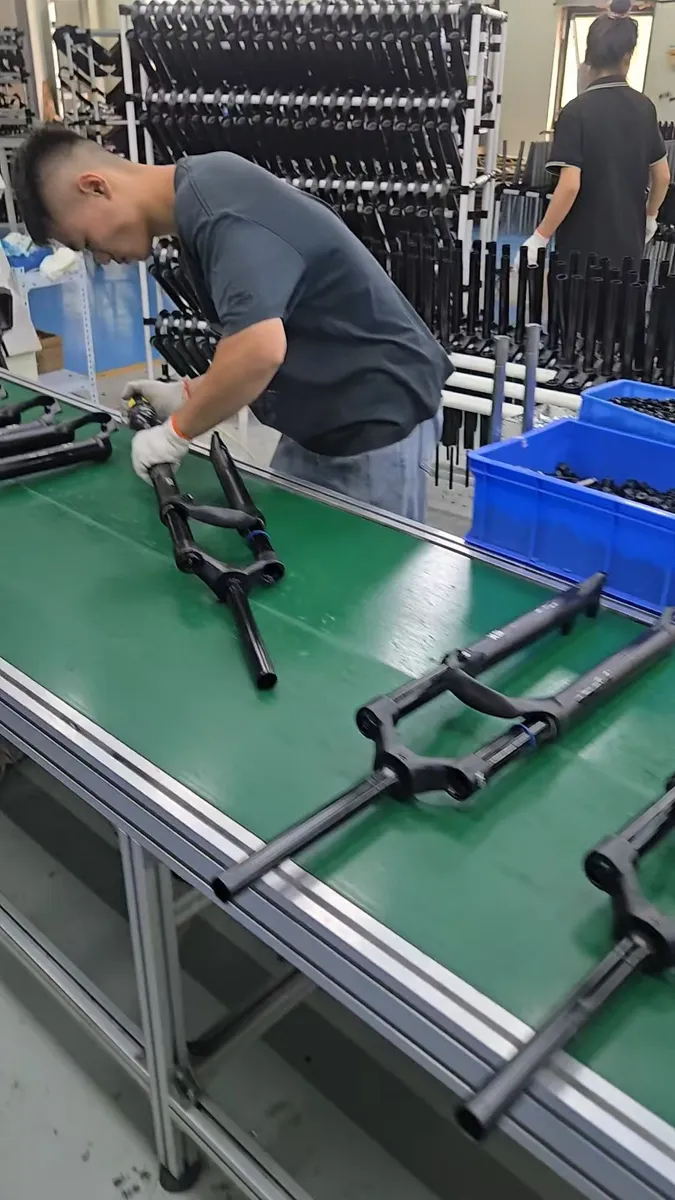
Bikes bound for Europe are tested to EN 15194, with the electrical system verified to UL 2849. Every bike passes a 100-percent powered aging test at line exit: motor no-load current check, one full battery charge-discharge cycle, and item-by-item display verification. Each quarter we pull complete bikes for a high-temperature cruise test — two hours at 45 °C in an environmental chamber, monitoring motor temperature rise and battery voltage sag. All test records are available to buyers at any time.
Configuration Advice for Buyers
Three honest recommendations. First, match the motor to the market: flat-city Africa and the Middle East take hub motors — easy to control cost; hilly Europe takes mid-drives, where torque and ride feel are the selling points. Second, when in doubt, upsize the battery: capacity is the parameter that most directly drives repurchase and word of mouth — at the same price, 50 extra watt-hours reads completely differently in customer reviews. Third, never buy the three components separately: we have seen buyers assemble their own sets, hit protocol mismatches between display and controller, and lose two weeks to rework. Our warranty is two years on the complete bike and two years on the battery, with the three-component failure rate currently held under 1.5 percent. Send us your requirement sheet and target market, and we will return three complete-bike configurations for comparison.